blackToe 2'x4' routing area Version 4.0 CNC Machine Kit: $2300.00
blackToe 2'x4' routing area Version 4.0 CNC Machine Kit without electronics: $1830.00
See the section below for an itemized part list with prices
Optional Table: $300
See the section below for a short video on the parts configuration.
About the blackToe 2x4 Version 4.0:

A new toy for The Next Industrial Revolution! Everyone with a garage (or a spare bedroom) can get serious with their creations on the cheap. Version 4.0, a solid, fast, attractive chain driven CNC machine. This CNC machine offers 3 axis functionality driven by roller chain and sprocket for the x and y axes and lead screw for the z-axis. The overall structure is solid with respect to stresses in all directions. Chain drive for this CNC machine will allow velocities into the 800 to 1000 ipm (inches per minute) range. Unlike the previous version, a table is offered as an optional add-on.
The first difference you will notice from the previous version (2.2) is the structure. Structure for rigidity is one of the most important factors in the design of these machines. Notice how the main y horizontal sp
ans also serve to add rigidity for y axial stresses (lateral forces) by wrapping around the gantry side. This condition of adding structure to the gantry sides exists on both sides and are fastened into the gantry side in two directions for added stability.
As a trained designer, aesthetics was hugely important in the development of these CNC Machines. The version 4.0 in my opinion has some nice industrial design features. All of these design implementations were added keeping the function and structure in mind. The placement of the idler sprockets in line with the drive sprocket is one such aesthetic design approach. The x-axis motor (as in the blueChick) is hidden from view by the back structural sup
port. All of the parts that make up this CNC machine design was formed with a keen eye on aesthetics.
The x-axis stepping motor is located within the mid point of the gantry as opposed to the lower portion of the gantry sides. Also markedly different with the previous blackToe CNC machines, there is only one x-axis motor. The mount for the x-axis motor can accept either a NEMA 23 frame or a NEMA 34 frame if more power is desired. The location of the x-axis motor allows the machine to extend shafts to both sides of the gantry to drive two roller chain systems (keep the gantry square and eliminate any racking). This has a couple of advantages: the gantry is squared only one time. Previous versions required a squaring at machine startup. Second, by having the x-axis motor above the machining and not below the table, cabinets, or other types of structure can reside u
nder the table.
The z-axis can reach 5-7/8 inches (149.225 mm) of travel. The entire z-axis mechanism has bee revamped in line with the blueChick CNC Machine. Unnecessary leadscrew length has been removed by locating all bearings and at the top of the axis. At the full down position, the top collar is touching the lead nut and at the full up position (where the end of the rails meet the lower bearing) the end of the lead screw meets the lead nut.
As with the previous versions, the z-axis uses an anti-backlash nut mated with a 1/2 inch lead screw. the lead screw specifications: 1/2 inch dia
meter, ACME precision thread, 10 threads per inch at 5 starts which translates to two (2) turns per inch. With very complex carving, the z-axis can handle fast up and down movements and remain at a relatively low motor rpm to increase torque at these speeds.
One of the more interesting enhancements in the version 4.0 is the vacuum attachment. The same upper holder remains in this version, but the lower vacuum mount is completely re-designed. The vacuum mount now re-directs the air flow from the center point of the router (where the end mill or router bit is located) to the vacuum hose. Now, a brush, or plastic shield can be installed right around where the cutting happens.
By re-directing the air in this way, there is the added benefit to helping cool the router motor. Router motors have a fan attached to the lower part of the housing that spins using the router motor. This acts as a cooling element and a method of blowing chips out of the way so there is visual clearance
while hand routing. Since there is no hand routing here, blowing the chips everywhere is not the best thing. Instead, the blowing is blocked by the bottom of the vacuum mount and is re-directed into the vacuum along with the chips. The vacuum may also remove any debris that may enter the router motor.
All of the stepping motors are in close proximity to each other. Wiring is much simpler with this CNC machine. The z-axis stepping motor wires can be routed towards the y-axis stepping motor. At the y-axis stepping motor, both the y-axis stepping motor wires and z-axis stepping motor wires can be routed towards the point where the x-axis stepping motor wires exit the gantry box. From that point, all of the wires can be routed to the stepping motor drivers.
Roller chain is kept as the main drive mechanism and transmission of linear motion due to its great characteristic of low maintenance and low to no backlash. The roller chain drive system has decreased in size for this version. Instead of using #40 chain as in the previous version, this machine is using #25 chain. The difference between these two sizes is mainly the pitch. The pitch is the distance from one link to the other, or from the crest of a sp
rocket to the next crest (a crest is the high point of a tooth of a sprocket). The pitch for the #40 chain is 1/2 inch (12.7 mm) and the pitch for the #25 roller chain is 1/4 inch (6.35 mm). There are two main reasons for changing the roller chain size. First, the #40 chain is heavy. In reality, the #40 chain is perfectly fine for these machines, but the weight requires high tension to be applied to the chain, which requires more structure to keep the chain in tension. The #25 roller chain is relatively light and can tension very easily. The second reason is the effective increase in resolution. The resolution for the #25 chain in relation to the #40 chain is doubled. Resolution is very important with CNC machines when PCB fabrication or intricate carving is required. Even though the #40 chain can be microstepped using the drivers to increase the resolution, the torque is reduced at higher microsteps. The #25 chain is a great balance with keeping torque high and maintaining a very high resolution.
Let's go ahead and do the math to determine the resolution (steps per inch). A standard stepping motor provides 200 steps per revolution (1.8 degrees per step). It's never
recommended to set a driver for full step, so let's assume that the drivers are set to 1/16 microstepping for the stepping motors that are to drive the chain (not the lead screw). I generally recommend 1/16 for microstepping roller chain drives. There will be 16 steps for each full step. Simply multiply 200 steps per revolution by 16 and you get 3200 total steps per revolution. The sprockets that I use on this machine has 9 teeth. At the pitch of 1/4 inch, one entire revolution will yield 2.25 inches. Since we are looking for step per inch, we already know how many steps there are in one revolution, so all we need to do is divide the 3200 steps with the number of inches in one revolution (2.25 inches). So, 3200 steps per revolution divided by 2.25 inches is 1,422.2222 steps per inch.
For the lead screw, I recommend 1/4 microstepping. So, 200 steps per inch multiplied by 4 steps (per full step) is 800 steps per revolution. With lead screws, the math is a bit reversed since the mechanism is actually increasing the resolution. The lead screw, as mentioned above, yields 2 turns per inch. Since we are going the other way and the mechanism is multiplying the resolution, we need to multiply the steps per revolution by the number of turns per inch (2). So, the product of 800 and 2 is 1600. Another way to think about this (similar to the roller chain math) is to divide 800 by the number of inches in one turn, which is 1/2 inch. so, 800 divide by .5 gives us the same answer, 1600 steps per inch. you can increase both the roller chain and lead screw numbers by increasing the microstepping. Make sure to understand the torque at higher settings.
For the first time, the table is an option that can be included as an option. The table has four main parts that is assembled with ribs below similar to a torsion box, but will still need to be placed on a flat surface. For best results, the table assembly should be glued together and another full piece be glued to the bottom to create a full torsion box. To really take advantage of space, cabinets and/or drawers can be placed under the machine. Casters below that would allow for the machine to be somewhat mobile.
MDF has been replaced with birch plywood. This plywood has little to no voids and is stronger than MDF. The birch is also lighter than the MDF which could be less expensive for international shipments.
Parts not included:
Computer (Personal Preference)
Software (Personal Preference)
Router (Personal Preference although I recommend Porter Cable 2.25 HP 800 series)
Shipping:
Domestic shipments will be $120 shipping and handling
International shipments require a $600 deposit. This amount is subtracted with the actual shipping charges and the difference is refunded. Charges do not include duty, customs, tarriffs, or any of the other surprises that are associated with international shipments.
If paypal does not ask for your shipping address, please email me your address using this form (the Contact Us page).
blackToe Assembly Instruction Videos:
With these videos, we made a great effort to reduce the amount of assembly per video. This means there will be more videos, but less information per video. This will allow a more efficient process of assembly. If there was a particular part of an assembly that was missed, or need to return to at a later date, it will be much easier to find the steps to accomplish the desired task.
To see the wiring videos for the electronics, go here.
The first step in assembling the blackToe CNC machine is to begin with the maing gantry skeleton. The two gantry sides will be fastened to the main y-axis horizontal support piece. All of the screws will be 1/4" - 1-1/2" and they wil be mated to cross dowels. The holes that are on the y-axis horizonital piece that screw into the edge of the gantry are enlargened in contrast to the standard 1/4" holes. This is to compensate for the variable thicknesses of the birch plywood.
The second step will exhibit the assembly of the bottom of the y-axis support box (gantry box) face to the main horizonital piece, the x-axis motor mount inside the gantry box, the y-axis top rails and top rail support and the top gantry box face.
The third step continues with the y-axis rail to complete the assembly by attaching the bottom rail and support. This bottom portion support and rail is designed to be adjustable so the v-groove bearings have a good amount of pressure on the rail.
The fourth step includes the assembly of the router mount, mid z-axis rail assembly and attaching the z-axis rails.
The fifth step will show the installation of the vacuum transfer assembly and the top z-axis bearing mounts.
The sixth step shows the v-groove bearings that are installed onto the z/y plate. These bearings are used to guide along the y-axis rails on one side of the plate and guide along the z-axis rail assembly on the front of the plate.
In the seventh step, the y-axis roller chain end supports are installed and on the z/y plate, the y-axis motor mount is installed along with the idler sprocket.
In Step 8, you will see the installation of the table rails and the gantry v-groove bearings and idler sprockets.
In step 9, the x-axis motor will be fastened to the gantry mid section, the rods will be coulped to the frint and back of the motor, the sprocket and bearings will be added to the rods and the chain will be fastened to both sides of the x-axis.
In step 10, the y-axis motor and mechanics are installed. This includes mounting the motor to the y-axis motor mount, adding the drive sprocket to the motor shaft, weaving the chain through the drive and idler sprocket and fastening and tensioning the chain at the y-axis rail ends.
In step 11, the z-axis motor and motor mount is add to the z-axis assembly.
This video shows the installation of the chain mount for each corner of the table. this chain mount holds the chain at each end for the x-axis. One end has a slot for the eye bolt and the other end has two holes for the clamp.
When you get to the wiring for the electronics, go here for the video instructions.
Optional Table:
If the optional table is purchased, here is a short video on its configuration. The table is shown upside down to illustrate the structural pieces and their proper placement that are fastened to the bottom.
Table construction:
The following information is provided to help in a custom table build. These images demonstrate the recommended method for the table construction. The overall table is a simple structure as the base with a shelf and the main table and surface is is a torsion box table. The name torsion box describes the internal ribbing sandwiched by two layers of boards. This technique of ribbing resists torsion (twisting) of the table so that the entire table will be level in any direction.
To insure this the table will need a surface that is dead level. The best way to do this is to use winding sticks and a level on a surface that can be leveled with shims. Winding sticks are used to make sure there is no torsion existing in the base when starting the construction. these winding sticks are placed at each end of the board and just be looking at the two winding sticks from one end, the torsion can be identified and corrected. This is best see in the videos from the Wood Whisperer or David Marks.
There are a couple of aspects that must be followed: The table must have a width between 26-3/4" and 27", there must be an overhang of at least 1" (I recommend 1-1/2") along the sides and there must be a clearance of 1-3/4" from the edge of the table to the start of the rail.
In the image to the left, the table has a dimension of 6 feet by 2 feet and 2-3/4". the 2' 2-3/4" is 26-3/4". This is a minimum dimension for the width so the gantry will fit correctly.
The 6 feet can be longer or shorter; however, since the gantry side is about 17 inches in length, this takes away from the x-axis travel, so the table should be at-least 18 inches longer in the x-axis direction. I recommend that 2 feet be added to the x-axis length so there is some wiggle room at both ends.
The table length can be increase according to the desired x-axis travel length. For example, if the desired x-axis travel is 8 feet, the table length should be 10 feet to compensate for the
gantry structure.
Since the x-axis rails need to be fastened to bot the top and bottom sides of the table, the top surface should overhang 1-1/2" on both sides. This means that the torsion box, or the structure just below the table surface should be a maximum of 23-3/4" so that this clearance can be established.
The table top should be 3/4", but can be up to 1" in thickness. the lower v-groove bearing slots on the gantry sides allow for this adjustment.
To make room for the parts that hold the x-axis chain, the rails should start 1-3/4" from the edge of the table and provide the same clearance at the other end.
The following set of inages show one example of a table that would work as a base for the 2x4 blackToe CNC Machine. There are many possible variations (table without torsion box, cabinetry under table, etc.). This deminstrates an example for use as a possible method, but I would encourage differernt table structures and features.
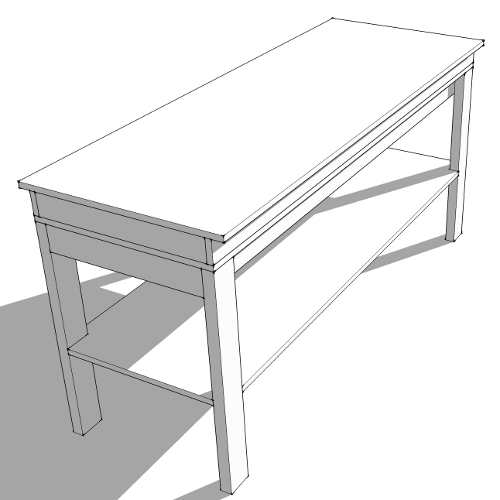
This is the table fully assembled. the talbe consists of standard 2x4 studs for legs and frame. The middle shelf is used for storage and stability. More structure underneath will stiffen the overall structure. just above the base is the torsion box structure and table top.

An exploded view of all table parts.
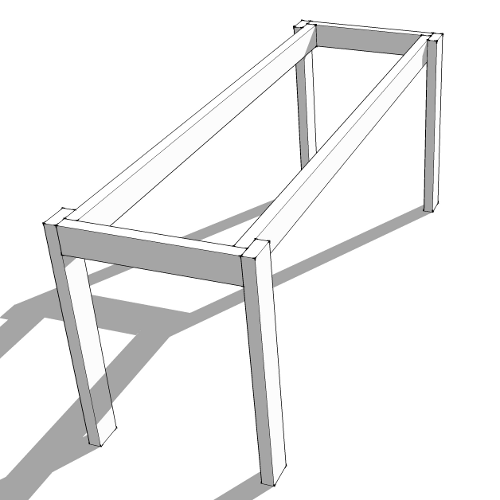
Table legs and frame.
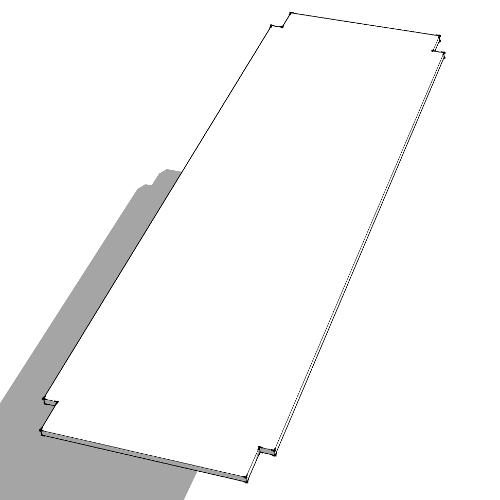
Shelf
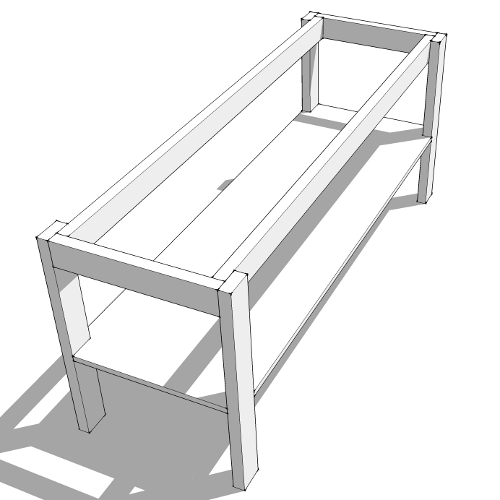
Shelf and frame together.
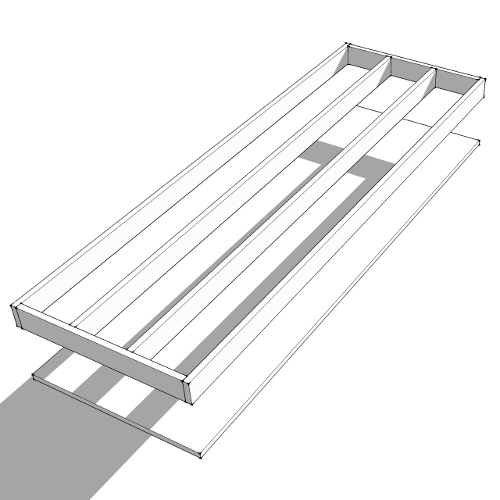
Torsion box - bottom layer and initial long ribbing.
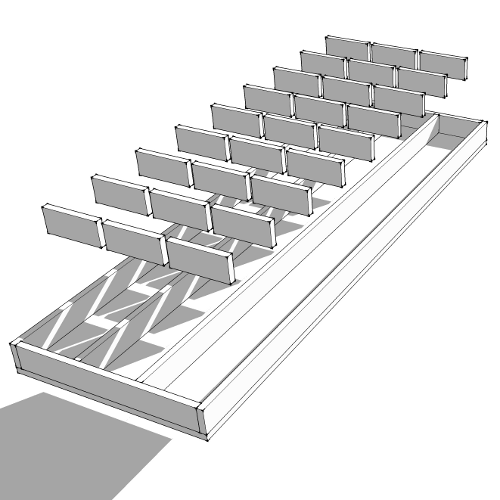
Lateral pieces to complete the grid.
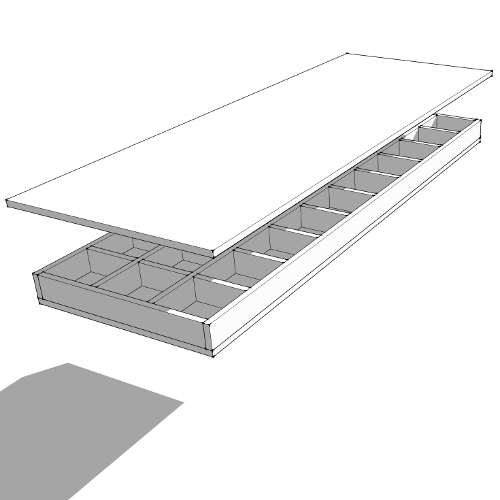
The top layer.
blackFoot 2'x4' routing area Version 4.0 g-code files for the MDF pieces: $300.00
I am offering the .nc files due to overwhelming requests. These need to be run on a CNC machine. The price is factored by many aspects of the research and development of the blackToe machine and that this website survives by the sales of these machines. Remember that these files are licensed under the Creative Commons Attribution-Non Commercial and are have copyright restrictions. For the g-code execution: Each board measures 2'x4' with a 1" clear border to maintain structure while routing. The z-axis is positioned where the tip of the end mill meets the surface of the material to enable easy cutting with a flat end 1/4" end mill, the depth per pass is set at 0.17".
Packing List:Top and Bottom Gantry Box (2)
Y-Axis Rail Support Top and Bottom (2)
Y-Axis Rail Support Reinforcement (1)- Z/Y Plate (1)
- Z-Axis Rail Supports (2)
- Z-Axis Middle Supports (4, 2 long and 2 short)
- Router/Spindle mounts (2)
- Vacuum Mount Bottom (2 Parts for Suction Enclosure)
- Vacuum Mount Top and Lead Screw Bearing Mount (1)
- Z-Axis Lead Screw and Bearing Mount (1)
- Y-Axis Chain Mount (4 - 1 long and 1 short and their respective clamps)
- Y-Axis Motor Mount (1)
- X-Axis Chain Mounts ((16 - Assemblies that are affixed to the table corners)
Hardware List:
Screws (#8) @ 1 1/4" (24)
Screws (1/4") @:1" (16)
1-1/2" (77)
2" (40)
2-1/2" (4)
3" (14)
3-1/2" (4)
Screws (3/8") @:- Nuts:
#8 (18)
1/4" (46)
Cross dowels (114)
3/8" (28)
- Eye Bolts (3)
- Hose Clamps (3)
- Washers:
For #8 Screws (16)
For 3/8":
- Small L-Brackets (For Anti-Backlash Nut) (2)
- Bearings:
"V" Groove (3/8" Inside Diameter) (16)
Standard with 1/2" Inside Diameter for Lead Screws (2)
1/4 Inside Diameter for X-axis Motor shaft Ends (2)
- Couplings:
- 1/4" to 1/2" (1)
- 1/4" to 1/4" Rigid For X-Axis Shafts (2)
- Steel Collars (1/2" Inside Diameter): (1)
- Z-axis 10.5" lead screw (1)
Anti-backlash nut (1)
Drive Sprockets #25 9 teeth (3)
Idler Sprockets #25 25 Teeth (5)
Roller Chain #25 - Length show extra chain provided for convenience
8 Feet for X-Axis (2)
4 feet for Y-Axis (1)
Rods at 1/4" Diameter and 14" in Length (2)
Electronics:
Stepping Motors at 425 oz-in NEMA 24 (3) - note NEMA 24 is a 60 mm Frame Size
Motor Drivers at 3.0 amps Max Rating and 1/64 Microstepping (3)
Power Supply 36v-8.8amp (1)
Power Supply 5v (2)
Breakout Board for Computer Interface (1)
Optional Table
1/4 - 1.5" Screws (70)
Cross dowels (70)
Birch or MDO Pieces for: